Iker Castège, Oceanographer, Director of the Centre de la Mer
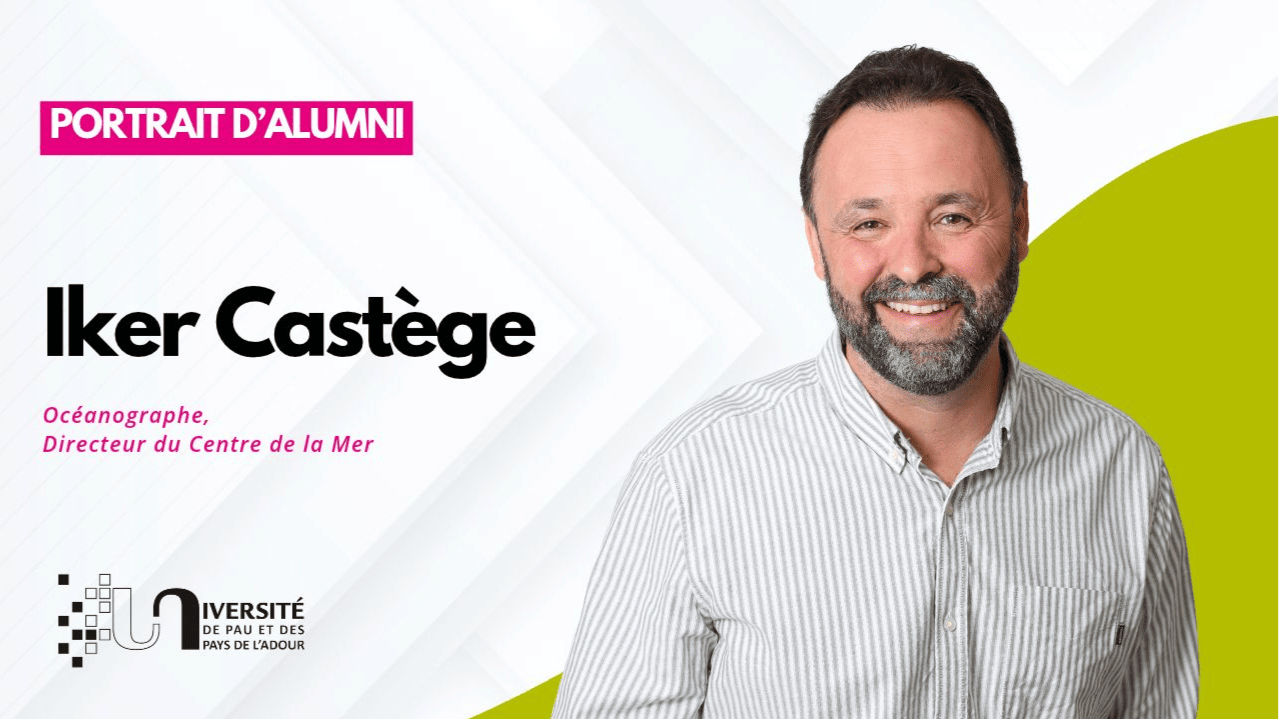
Committed to research, raising awareness and teaching about oceanic and climate phenomena, as well as protecting marine biodiversity, Iker Castège holds a PhD in Physiology and Biology of Organisms, Populations and Interactions, awarded by UPPA in 2009. The journey of a passionate oceanographer...
You are committed to protecting the marine environment. At the time, how did you envision your professional future?
I had not necessarily planned to become an oceanographer, even though I had a strong interest in aquatic ecosystems, nature and their biodiversity. I began with a DEUG in Life Sciences at UPPA, which gave me a broad foundation in science. In 2000, after completing a Bachelor's degree and a Master's degree in Biology, I went on to pursue a DESS in Aquatic Ecosystem Dynamics (DYNEA). In 2008, to support my research work at the Centre de la Mer, I undertook a PhD in Physiology and Biology of Organisms, Populations and Interactions at UPPA, which I completed in 2009.
When did your commitment to oceanography take shape?
My commitment to oceanography developed through my student internships and the people I met along the way. I completed an internship at the National Museum of Natural History in Paris, then carried out a mission for the Ministry of the Environment focusing on the impact of the Erika oil spill. These two experiences were decisive in my choice to become an oceanographer. As someone deeply attached to the Basque Country, I became aware at that point that we have extraordinary marine ecosystems right here in our region that we need to protect. I committed myself to this challenge for the future by supporting the creation of the Centre de la Mer. Over the years, a team of experienced oceanographers was recruited, and several of my colleagues also obtained PhDs to support their work in research, documenting and sharing knowledge about local marine biodiversity.
What did your studies at UPPA bring you? And what connections do you maintain with the University?
My ties with the University are very close, as I began teaching on various programmes at UPPA immediately after obtaining my DESS. My work at the Centre de la Mer has also led to partnerships with several research laboratories. I supervise many UPPA students on internships, some of whom have gone on to be recruited by the Centre de la Mer.
What are your memories of campus life?
I have very fond memories of the people I met during the DYNEA DESS programme, which had only just been created. As a student, I took part in establishing the programme on the Montaury campus in Anglet.
I have fond memories of the friendships I made during this small, close-knit programme, where we were a small group of students. We had very close relationships with our lecturers. Today, I share my teaching experience with some of them. This ongoing exchange with UPPA is very enriching and also helps expand one's professional network.
What message would you give to a current UPPA student preparing for their future career?
I would advise them to persevere in pursuing their career goals, because research and the protection of marine biodiversity in our region are genuine challenges for the future.
I would also encourage them to have confidence in the quality of the education provided by UPPA, which is perfectly suited to developing local knowledge and understanding of these challenges. Our professions are fascinating and involve working on issues that will shape the future, because our coastline presents both significant challenges and many potential solutions. Recruitment needs will grow alongside these challenges.
Interview by Séverine Cuesta
Find out more
Bachelor's degree in Life Sciences
Master's degree in Aquatic Ecosystem Dynamics (DYNEA)

Comments0
Please log in to see or add a comment
Suggested Articles