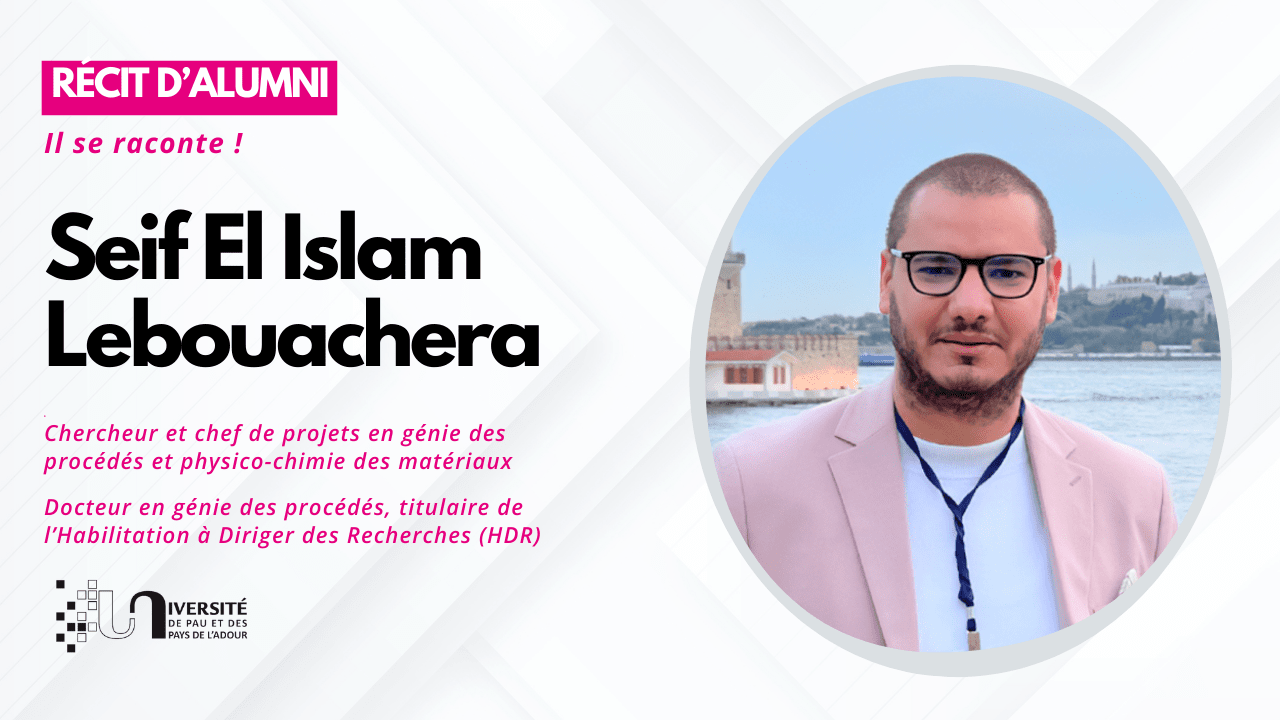
Seif El Islam Lebouachera, researcher and project manager in process engineering and physical chemistry of materials, Doctor of Process Engineering, holder of the Habilitation à Diriger des Recherches (HDR) qualification

What led you to choose to pursue a PhD?
Coming from Algeria with a background in Chemical Engineering, my ambition was to further specialize in the physico-chemistry of materials and to integrate more advanced experimental and numerical approaches.
After being awarded the PROFAS B+ international doctoral scholarship, I joined UPPA in 2017 to conduct a joint PhD USTHB–UPPA, which perfectly reflected my desire to develop rigorous and demanding research, work on real industrial problems (EOR in partnership with SONATRACH and CNRS), and strengthen a dual academic base (Algeria–France). This path was a logical continuation of my studies in Algeria (USTHB, SONATRACH) and aligned with my goal of acquiring expertise transferable to the energy, water, and materials sectors.
What was your main mission during your PhD?
My main mission was to develop, characterize, and optimize chemical formulations for enhanced oil recovery (cEOR).
It was based on three main areas:
1. In-depth experimental study of the rheology of complex polymer–microparticle systems, thermal/mechanical stability under extreme conditions (Algerian reservoirs).
2. Advanced characterization: Capillary viscometry, FTIR, BET, XRD, microscopy, zeta potential, UV-Vis…
3. Modeling and optimization: Design of experiments, predictive models,
This work was conducted in direct connection with industrial issues (SONATRACH) and high-level laboratories (UPPA, UMR5254), which greatly shaped my current expertise.
What tangible benefits do you gain from this experience today?
This PhD gave me solid dual skills : advanced academic research + industrial understanding (oil processes, water treatment, materials), recognized scientific expertise in adsorption, polymer–microparticle formulation, physico-chemistry of porous materials, rigorous methodology : modeling, DoE, applied AI, multi-scale analysis, and a formative international experience, which facilitated obtaining my MCF qualifications (sections 32, 33, 62) as well as the ability to coordinate multidisciplinary projects, now essential in my R&D and industrial roles.
How would you describe your doctoral experience in 3–4 words?
Educational – Structuring – Demanding – Decisive
If you had to do it again, would you make the same choice?
Absolutely. Choosing an international joint PhD provided me with a top-level scientific environment, international exposure, strong industry–lab interactions, and diverse career opportunities (academic, industrial, European projects).
It is a demanding path but one that opened the way to my Habilitation à Diriger des Recherches (HDR) in Chemical Engineering (UPPA, 2025) and co-supervision of several PhDs.
After the HDR: industry or academia?
After the HDR, I remain open to both academia and industry. Both environments truly interest me and I see them not as opposites, but as complementary.
Academia allows for high-level research, training young researchers, and building ambitious scientific partnerships. Industry, on the other hand, offers a stimulating environment where ideas can quickly be transformed into tangible solutions, with direct impact on processes, materials, or the environment.
My goal is not to choose one over the other, but to invest where I can bring the most value: leading R&D projects, building bridges between labs and companies, or developing transferable innovations. The framework matters less than having purpose, challenge, and the possibility to contribute meaningfully. This flexibility has always guided my path and will continue to shape my future choices.
Any final words?
My journey between Algiers and Pau, and between industry and research, taught me that success relies on navigating scientific demands, industrial expectations, and societal needs. My PhD and later my HDR are above all unique human and professional experiences, which help build a strong scientific identity and a coherent, engaged, and meaningful career.
Learn more?

Comments0
Please log in to see or add a comment
Suggested Articles